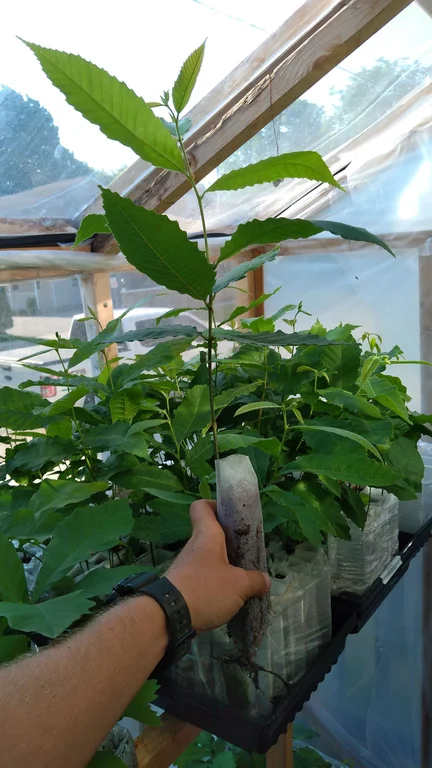
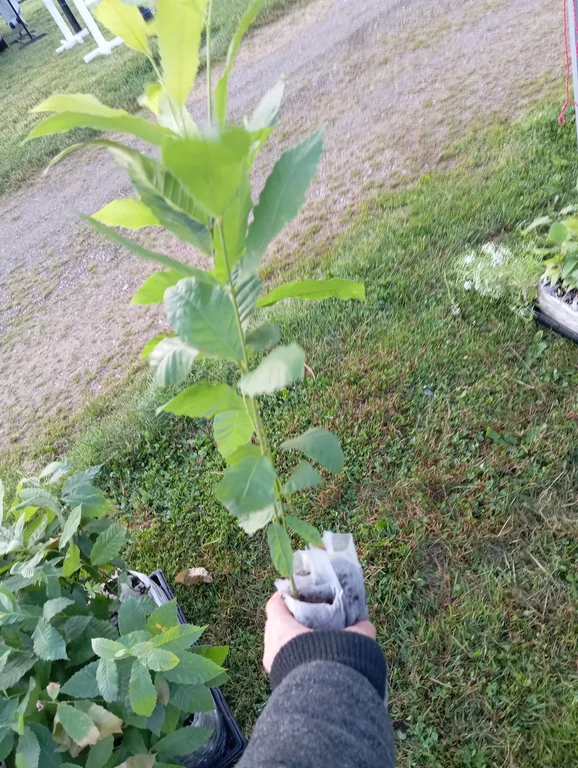

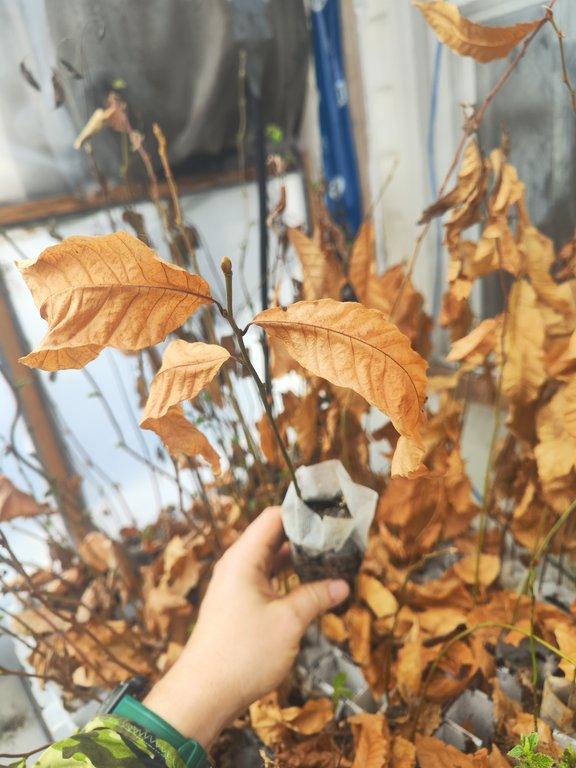
Nut Trees Item Code: LYIS-SWEET-SOFT-CHESTNUT-250ML-2YR
These are ready to plant Sweet Chestnuts from parents that grow in Ontario, based mostly on Chinese Chestnut (Castanea mollissima) genetics for resistance to the chestnut blight.
In the second image you can see the size of the edible nut which they produce.
Castanea mollissima is hardy from zones 4-8, in sandy, loamy, and heavy soils, which are acidic and neutral, grows up to 25m tall.
They will start to bear fruit within 5-10 years.
Like all our seedlings these have been well cared for and have been given nutrients to promote good vigour and disease resistance,
including nitrogen, calcium, magnesium, phosphorous, potassium, iron, manganese, zinc, copper, boron and molybdenum.
They can be planted in the pots they come in.
These are live plants, so need quick shipping options, can combine multiple in one shipment.
Generally for fruit set you want to have at least 2.
For planting instructions check out https://lyis.ca/pfet/2022-spring-pfet.pdf
Species Information
Sweet Soft Chestnut (Castanea mollissima) - Productive Blight-Resistant Chestnut Tree
Chinese chestnut is one of the most reliable chestnut species for home orchards and diversified farms in much of eastern North America. It is valued for its sweet nuts, strong resistance to chestnut blight compared with American chestnut, and its ability to produce well in a wide range of temperate climates.
This medium-sized tree usually develops a broad, rounded crown and begins bearing nuts relatively young compared with many other nut trees. In late summer to autumn it produces spiny burs that split open to release glossy brown chestnuts. The nuts are sweet, starchy, and easy to use roasted, boiled, or in flour and baking.
Chinese chestnut grows best in full sun on well-drained, slightly acidic loam or sandy loam. It dislikes heavy, poorly drained soils and sites with perched water, which increase root disease risk. Once established it is fairly drought tolerant, though regular moisture improves nut size and consistency of yields.
Why plant Sweet Soft Chestnut:
- Sweet, versatile nuts for fresh eating and cooking
- Strong resistance to chestnut blight compared with American chestnut
- Productive tree for homesteads, orchards, and agroforestry plantings
- Good wildlife value as a mast-producing tree
- Long-lived and attractive shade tree with edible yield
Growing conditions: Plant in full sun for best nut production. Use well-drained, slightly acidic soil and avoid frost pockets or poorly drained bottomland. Plant at least two compatible chestnuts for pollination and stronger yields.
Sweet soft chestnut is a practical choice for growers who want a dependable chestnut tree with good nut quality and broad adaptation.
Species Details
- Primary Trait: Edible
- Minimum Winter Temperature: -30 °C
- Optimal Temperature: 22 °C
- Maximum Summer Temperature: 35 °C
- Cold Stratification: 75 days
- Growing Degree Days: 2000
- Light: 15000 to 110000 lux; optimal 80000 lux
- Rainfall: 600 to 1400 mm/yr; optimal 900 mm/yr
- Soil pH: 5.0 to 6.5; optimal 5.8
- Soil Fertility (CEC): 8.0 to 28.0 cmol/kg; optimal 16.0 cmol/kg
- Sand Content: 20.0 to 75.0%
- Clay Content: 0.0 to 25.0%
- Hydraulic Conductivity: 0.5 to 10.0 cm/hr
- Traits: Edible, Nut Tree, Wildlife Friendly, Drought Tolerant
- Edible Uses: Nuts roasted and eaten hot Nuts boiled or steamed Chestnut flour for baking Soups, stuffing, and desserts Fresh nuts stored for later cooking
- Notes: Best performance is on well-drained loamy to sandy-loam soil with slight acidity. Avoid heavy clay, perched water tables, and frost pockets. Regular moisture improves nut size and yield consistency. Cross-pollination with another chestnut is recommended for strong production.