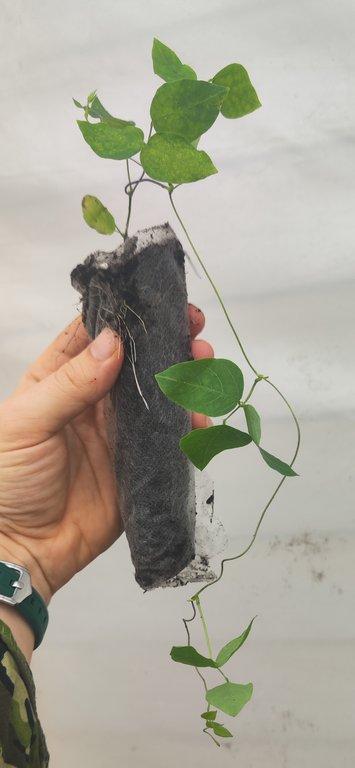
Bean Item Code: LYIS-HOG-PEANUT
All our plants are grown with seed from care and thus are genetically diverse.
At a young age they are paired with beneficial organisms like mycorrhizal fungi and beneficial bacteria.
They are grown in air-pruned pots, which helps them thrive upon transplanting.
These are the highest quality seedlings that science and love have yet been able to produce on this Earth, to our knowledge.
Species Information
Hog Peanut (Amphicarpaea bracteata) - Shade-Tolerant Native Vine with Underground "Peanuts"
Hog peanut is a native woodland-edge vine in the legume family that climbs by twining through nearby vegetation. It is valued as an understory food-forest plant because it grows in dappled light and shade, improves soil through nitrogen fixation, and produces edible seeds including distinctive underground "peanuts" formed from self-fertile flowers near the soil surface.
The plant typically grows 0.6-1.5 m long, with small pea-like flowers in late summer. It is commonly found along forest edges, trails, thickets, and moist meadows. It prefers soils that stay moderately moist, with good organic matter, and tolerates a wide range of soil textures.
Why plant Hog Peanut:
- Strong shade tolerance for woodland edges and forest gardens
- Nitrogen-fixing legume that supports soil fertility
- Produces edible seeds including underground "peanuts"
- Useful companion vine for native plantings
Growing conditions: Performs well from full shade to partial sun, with best vigour in consistently moist soils. Provide a shrub, fence, or light trellis for support.
Species Details
- Primary Trait: Bean (high protein)
- Minimum Winter Temperature: -40 °C
- Optimal Temperature: 20 °C
- Maximum Summer Temperature: 32 °C
- Light: 2000 to 90000 lux; optimal 15000 lux
- Rainfall: 600 to 1300 mm/yr; optimal 900 mm/yr
- Soil pH: 5.3 to 7.8; optimal 6.5
- Soil Fertility (CEC): 10.0 to 30.0 cmol/kg; optimal 18.0 cmol/kg
- Sand Content: 10.0 to 70.0%
- Clay Content: 0.0 to 35.0%
- Hydraulic Conductivity: 0.2 to 10.0 cm/hr
- Traits: Native, Edible, Shade Tolerant, Nitrogen Fixer, Climbing Vine, Wildlife Friendly
- Edible Uses: Edible underground seeds ("peanuts"), cooked or roasted Edible above-ground seeds, cooked Traditional peanut substitute in small quantities
- Notes: Often found in moist woodland edges and thickets. Seed germination commonly improves with cold moist stratification or fall sowing. Underground seeds can lose viability if allowed to dry fully.